If you are evaluating a kraft paper machine for a new mill or an upgrade project, the first thing you need is clarity on what the production line actually involves — from raw material pulping to the finished reel. That is what this page covers: the complete equipment lineup, real specifications from our product catalog, capacity ranges, and what drives cost.
Parason is a kraft paper machine manufacturer with 2,000+ equipment installations across 75+ countries. We are among the leading paper machine manufacturers and paper machine suppliers for kraft, tissue, board, and writing grades. From our experience commissioning kraft mills from 50 TPD to 1,200 TPD — whether running on OCC in India, virgin pulp in Nigeria, or bagasse in a craft paper mill in Brazil — we have learned that the right paper making machinery configuration makes or breaks a kraft mill's profitability.
What Does a Kraft Paper Mill Machinery Line Include?
A kraft paper mill machinery line converts waste paper (OCC, mixed waste) or virgin pulp into kraft paper for packaging, corrugated boxes, sack paper, and industrial wrapping. The complete line consists of four major sections:
- Stock preparation system — pulping, cleaning, screening, and refining
- Approach flow system — consistency regulation, deaeration, and headbox feed
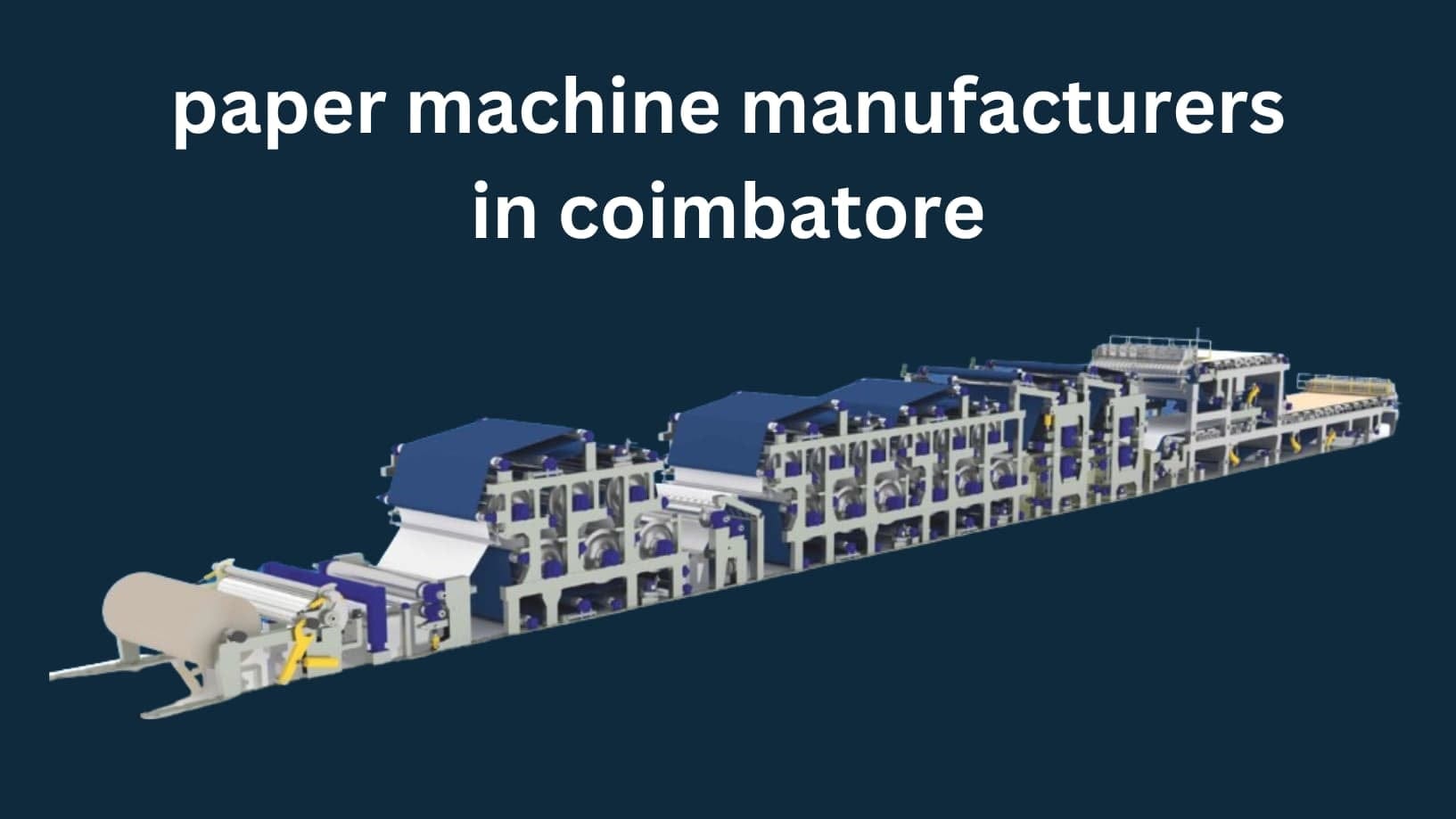
- Paper machine — forming, pressing, drying, calendering, and reeling
- Finishing and quality control — calender, size press, winder, and QCS sensors
Each section must be designed to match your target paper grade, GSM range, and daily tonnage. A 100 TPD kraft line and a 500 TPD line use fundamentally different equipment sizes, motor ratings, and automation levels. Parason builds complete lines from stock preparation through the paper machine and finishing, all engineered as one integrated system. For a detailed look at the kraft pulping process that feeds into this equipment, see our kraft process guide.
Stock Preparation Machinery for Kraft Paper
In any kraft paper mill, the stock preparation system does the heaviest lifting. It takes incoming OCC bales — often contaminated with tape, staples, plastics, and wet-strength adhesives — and converts them into clean, refined pulp that your paper machine can actually work with. Get this stage wrong, and every section downstream suffers: sheet breaks on the wire, holes in the finished paper, and customer complaints about contaminant specks. For equipment pricing details, see our pulp machine cost guide.
Pulping
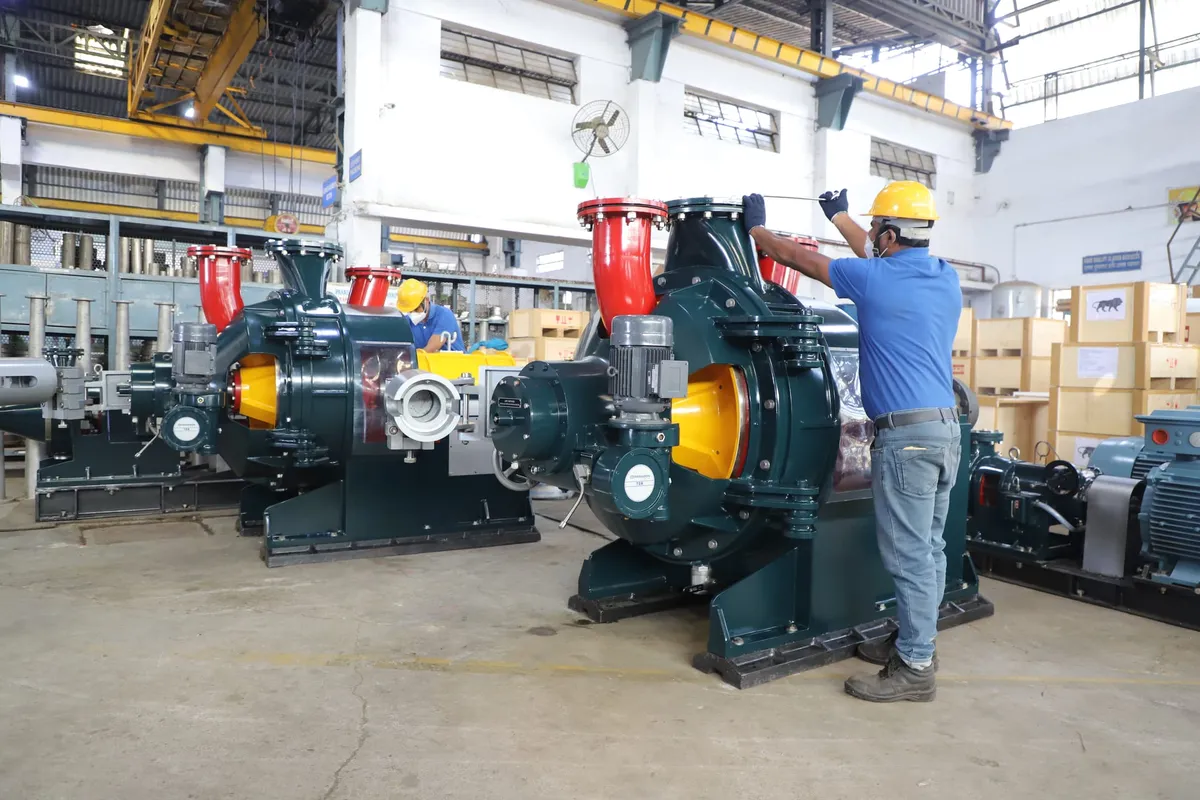
The first step is defibering — breaking baled waste paper back into individual fibers. Our HICON Pulper (HM Series) operates at 15–16% consistency for efficient defibering with minimal contaminant fragmentation — keeping contaminants large and intact for easier rejection through the screen plate. For larger kraft mills above 150 TPD, the SharpEdge Drum Pulper (PDP Series) handles 150 to 1,030 TPD continuously, with gentle pulping that keeps contaminants large enough to separate easily in later stages.
Cleaning and Screening
After pulping, HD cleaners (HDCS/HDCC Series) remove sand, glass, staples, and heavy contaminants. Coarse screens (VSM Series) handle initial contaminant removal at 20–610 TPD. Fine screens (VSL Series) then handle precision screening with slot widths as narrow as 0.10 mm, catching stickies and plastic fragments that would otherwise cause defects in finished kraft paper. Fine screen capacity ranges from 30 to 450 TPD depending on basket diameter and slot configuration. If your OCC source has high contaminant loads (common in mixed waste collection), adding an extra screening stage pays for itself in reduced downtime and fewer sheet breaks. For more on screening technology, see our guide on pressure screens in the paper industry.
Refining
Refining is where you build paper strength. Our Twin Disc Refiners (TDR Series, 8 to 600 TPD) develop fiber bonding that directly controls the burst factor (BF) and ring crush test (RCT) values your packaging buyers specify. The Conical Refiner (CR Series) offers 20–25% energy saving through its vortex centrifugal flow design. The right freeness target depends on your grade, GSM, and forming speed — it is something our process engineers configure during commissioning based on your actual raw material, not textbook values. Whether you call it a kraft paper manufacturing machine, a brown paper machine, a craft paper making machine, or simply a brown paper making machine — the refining stage is what ultimately determines your finished paper strength.
Kraft Paper Machine Sections
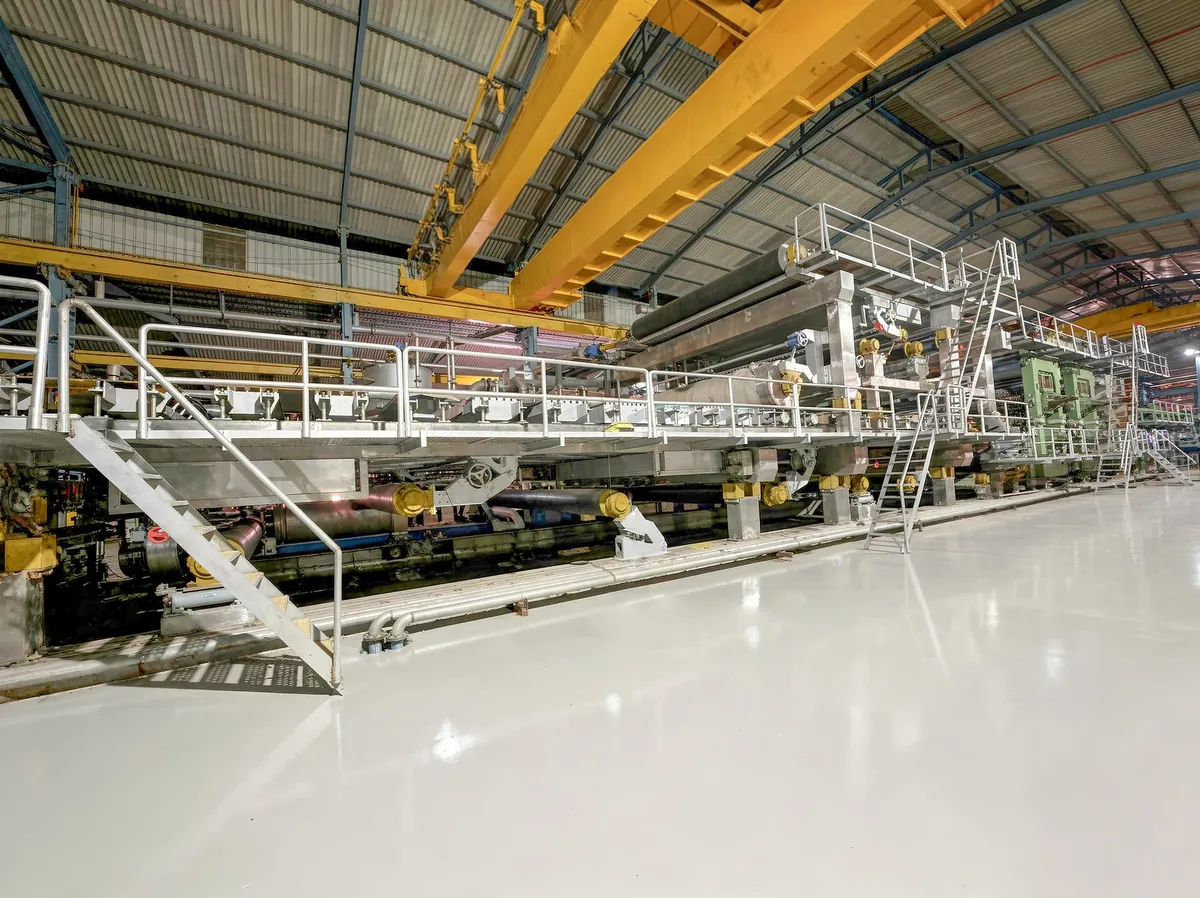
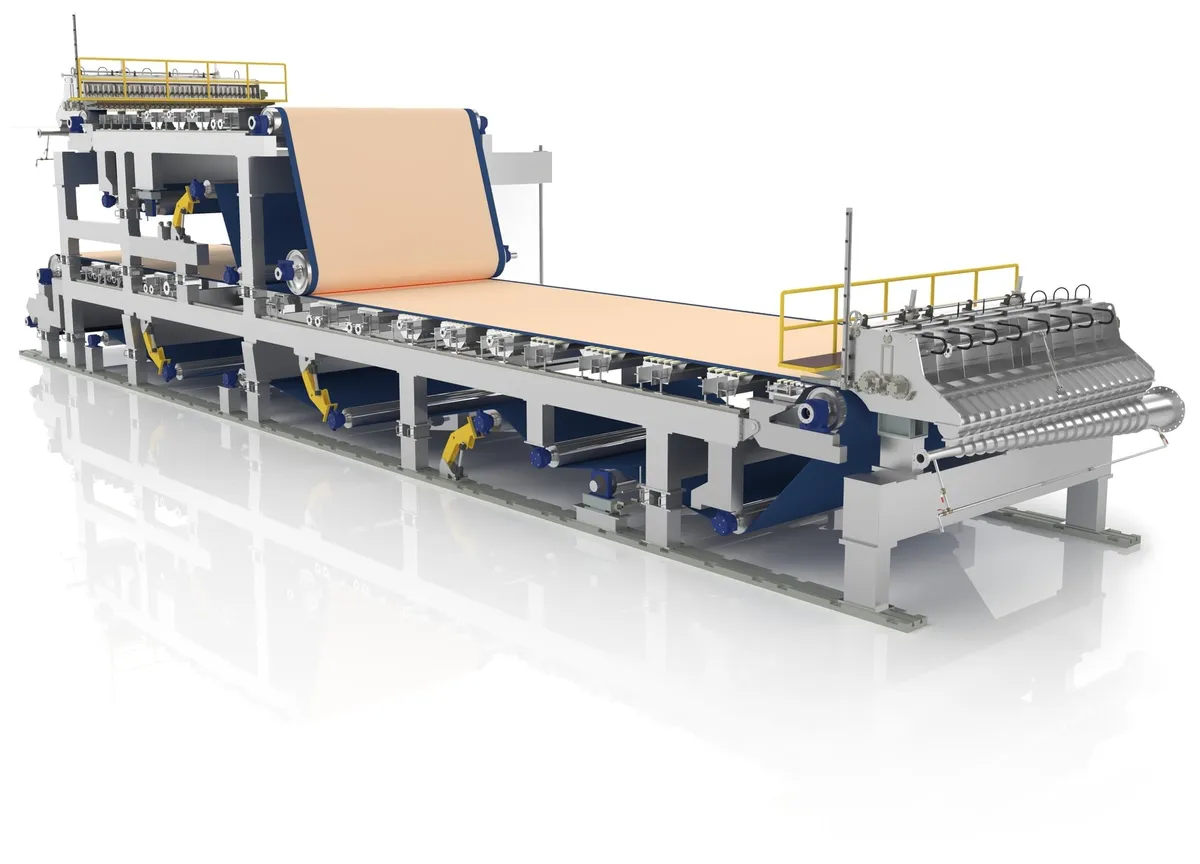
The paper machine is where pulp becomes paper — and where most of your capital investment sits. For kraft grades, the machine handles basis weights from 80 to 350+ GSM at speeds up to 1,200 meters per minute. Every section from headbox to pope reel has one job: remove water in the most energy-efficient way possible. Here is what each section does and why it matters for your operating cost. For a section-by-section breakdown, see our paper machine technology overview.
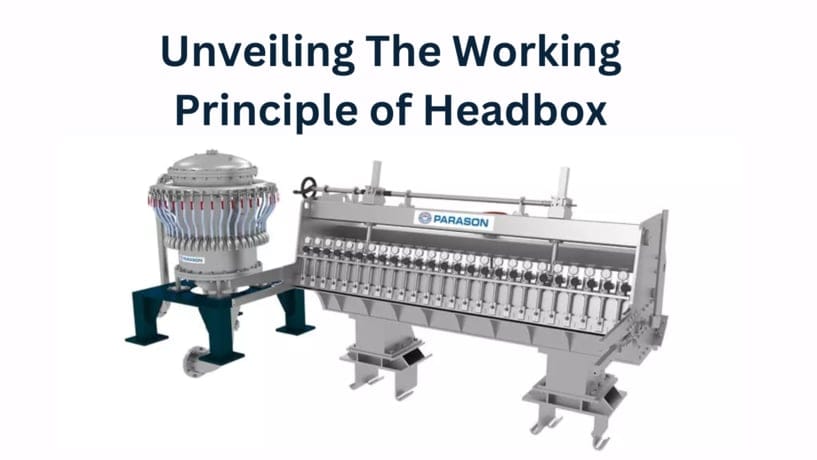
Headbox
The headbox distributes pulp evenly across the full machine width. For kraft paper, two options are common:
| Headbox Type | How It Works | Best For |
|---|---|---|
| Hydraulic headbox | Pulsation dampening, turbulence generator, automatic dilution control for CD basis weight | High-speed kraft lines with DCS/QCS integration |
| Pressurized headbox (air cushion) | Air cushion pressure, rectifier rolls, coarse and fine slice lip adjustments | Variable speed kraft production, lower to mid-range speeds |
Wire Section (Forming)
The wire section determines sheet formation quality. Kraft paper uses different wire configurations depending on the grade:
| Wire Configuration | Kraft Application | When to Use |
|---|---|---|
| Single wire (Fourdrinier) | Standard kraft, lower GSM kraft | Most common for single-layer kraft up to 200 GSM |
| Double wire | Kraft, white top liner kraft | Better two-sidedness, improved formation |
| Triple wire | Kraft, duplex, white top liner | Multi-layer forming for higher BF kraft |
| Four / Multi-wire | Multilayer high BF kraft, duplex kraft | Maximum strength for heavy-duty packaging, sack paper |
Multi-wire configurations produce kraft paper with higher burst factor because each layer can use a different fiber furnish optimized for strength, surface smoothness, or printability.
Press Section
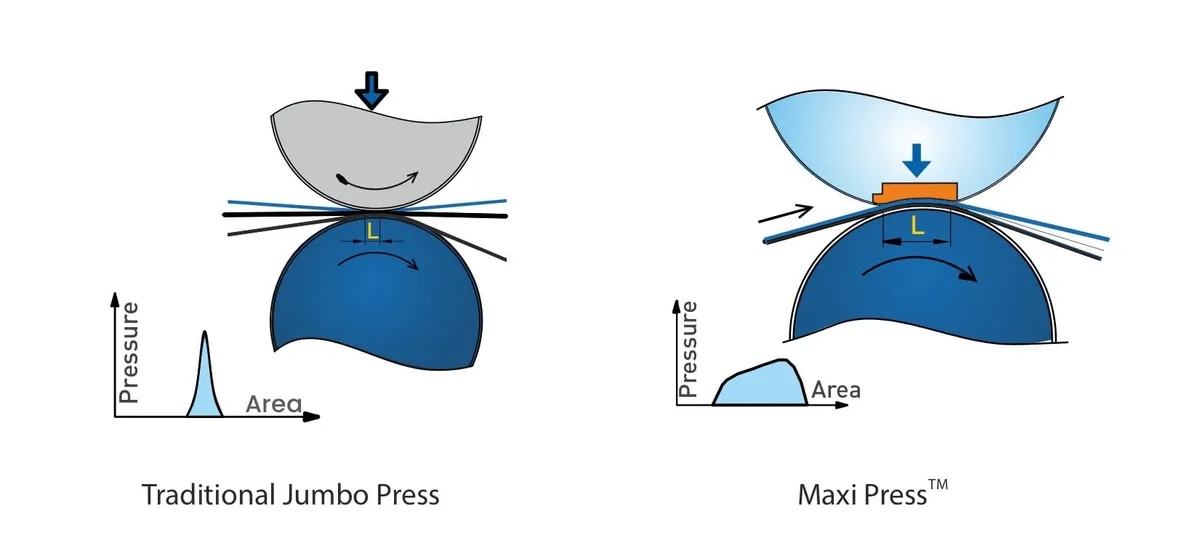
The press section removes water mechanically before the dryer section, which is critical for energy costs. Pressing is 10–15 times more energy-efficient than thermal drying. For kraft paper, three configurations are available:
| Press Type | Dryness After Press | Speed Range |
|---|---|---|
| Bi-Nip press | Standard (~42–45%) | Up to 400+ MPM |
| Tri-Nip press | Higher (~45–48%) | High-speed kraft lines |
| Maxi Press (shoe press) | Up to 48% dryness | Up to 1,200 MPM |
If there is one upgrade that pays for itself fastest in a kraft mill, it is the shoe press. Every 1% increase in press dryness saves roughly 4% in steam consumption. The Maxi Press significantly reduces steam and energy costs compared to conventional press configurations. For a mill running 24/7, this compounds into significant savings per tonne of production, year after year.
Dryer Section
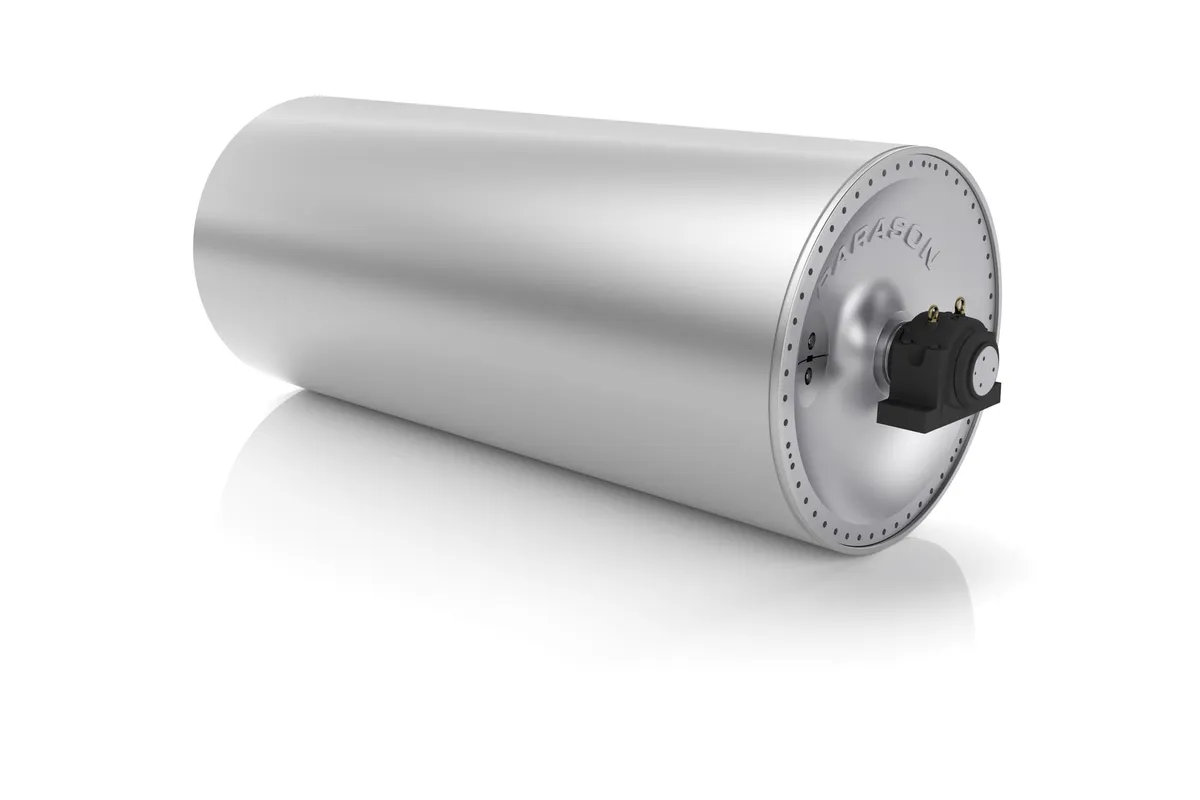
Multi-cylinder dryers with L-shaped and Y-shaped frames handle the remaining moisture removal. Cast iron dryers with cylinder diameters of 1,500–1,830 mm are standard. Steel dryers offer reduced shell thickness for better heat transfer and faster response to grade changes. Post-dryer cylinders are chrome-plated for surface finishing on higher-grade kraft.
Size Press and Calender
The size press applies starch coating for improved surface strength and printability, important for kraft paper used in corrugated box printing. Film press technology provides more uniform starch application than conventional pond-type size presses. The calender section uses hydraulic loading with soft and hard nip options, producing the surface smoothness that packaging converters require.
Pope Reel and Winder
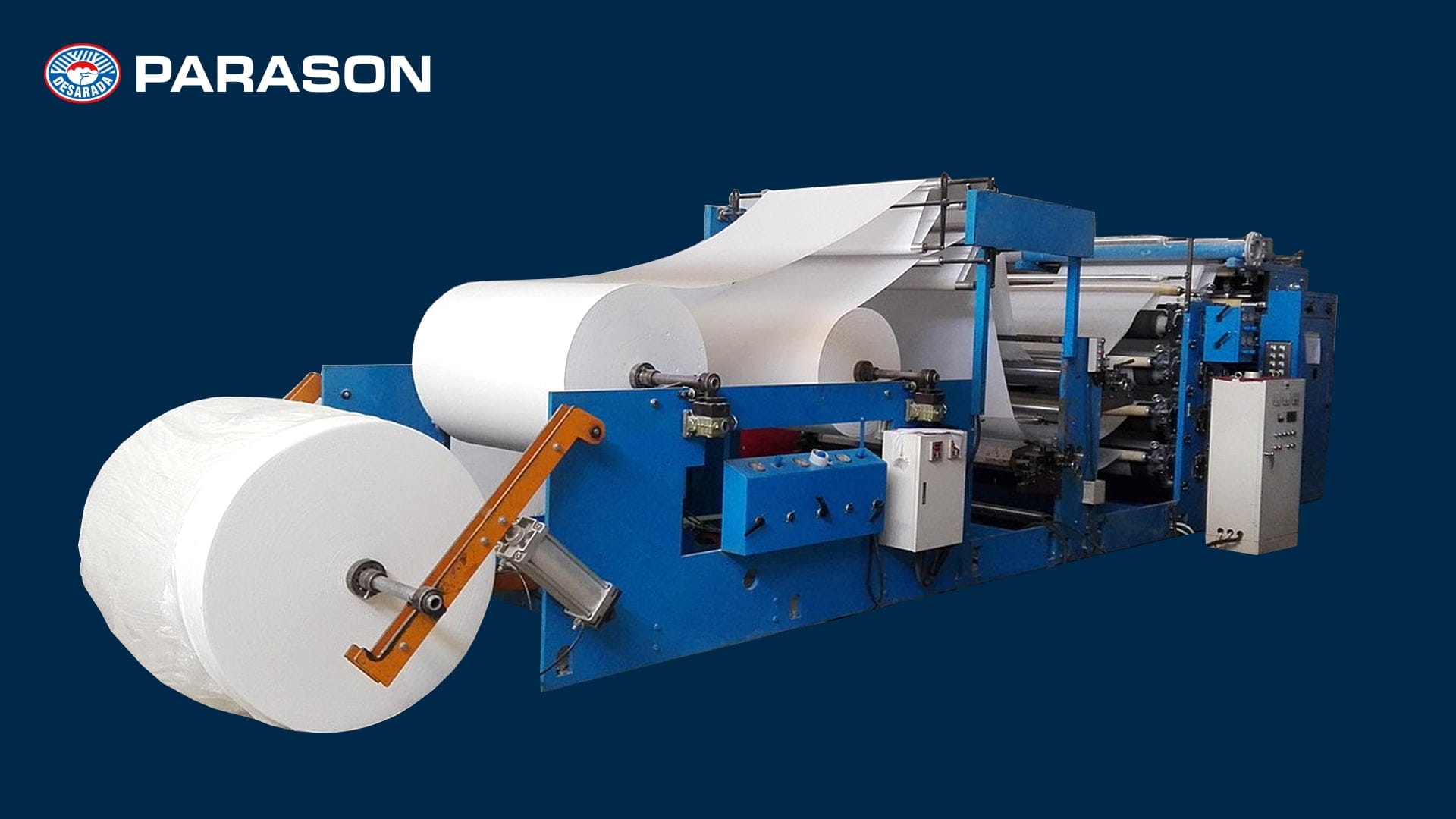
The pope reel with auto spool changeover winds the finished kraft paper into jumbo rolls. Cast iron or welded steel supporting drums with internal cooling systems maintain consistent winding tension. The rewinder then converts jumbo rolls into customer-specified reel sizes.
Capacity Ranges for Kraft Paper Machines
Parason manufactures kraft paper machines across a wide capacity range, from small mills serving local packaging demand to large export-oriented operations:
| Mill Size | Capacity Range | Typical Deckle Width | Typical Application |
|---|---|---|---|
| Small | 30–80 TPD | 2,500–3,500 mm | Local packaging, corrugated medium |
| Medium | 100–300 TPD | 3,500–5,500 mm | Regional kraft, sack paper, liner board |
| Large | 300–800 TPD | 5,500–8,000 mm | Export packaging, multi-grade production |
| Very large | 800–1,200 TPD | Up to 10,000 mm | High-volume kraft, integrated mills |
The most common capacity range for new kraft mills in emerging markets is 100–300 TPD. This range balances capital investment with market demand and allows room for capacity expansion later. For guidance on planning your mill setup, see our paper mill setup guide.
Quality Control and Automation
Modern kraft paper machines use Quality Control Systems (QCS) with scanning sensors that measure basis weight, moisture, and sheet temperature in real time. Scanner data feeds back to the headbox dilution system and dryer temperature controls for automatic MD and CD profile correction. Remote service through VPN allows troubleshooting without on-site visits.
DCS (Distributed Control System) and PLC control systems manage the entire production line from a central control room, reducing operator dependency and improving consistency across shifts. Parason partners with ABB for automation and IoT integration.
Turnkey Kraft Paper Mill Setup
For first-time investors, a turnkey paper mill project eliminates the complexity of coordinating multiple equipment suppliers. A turnkey kraft mill project from Parason covers:
- Feasibility study and market analysis
- Engineering design and civil drawings
- Complete equipment supply (stock prep through finishing)
- Installation and commissioning
- Operator training
- After-sales support and spare parts supply
When one manufacturer designs and builds the complete line, every section is engineered for the same target speed, deckle width, and GSM range. The paper machine runs as a coordinated system from day one.
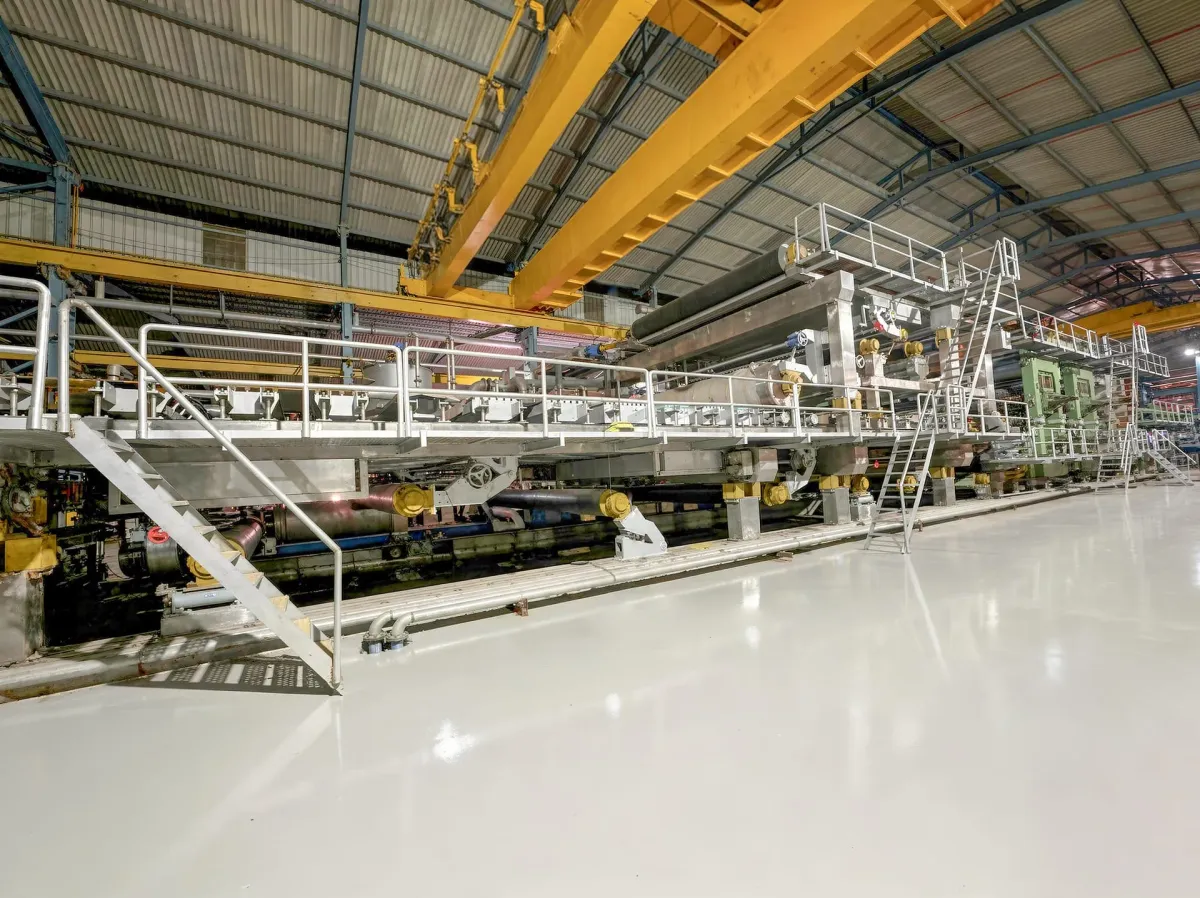
Kraft Paper Mill Installations
Parason has supplied complete kraft paper mill machinery to operations across multiple continents:
| Installation | Paper Grade | Capacity |
|---|---|---|
| Diyan Papers LLP | Kraft paper | 350 TPD |
| Sedy Egypt | Kraft paper | 220 TPD |
| Quantum Papers, Nigeria | Kraft paper | 300 TPD |
| KrishnaPrabhas Papers | Complete mill | 200 TPD |
These installations run on OCC and mixed waste paper as primary raw material, with stock preparation systems designed for the specific contaminant profile of each region's waste paper supply. With 2,000+ installations across 75+ countries and 50+ years of manufacturing experience, Parason's engineering team has built kraft mills across varied infrastructure conditions.
Kraft Paper Grades and Applications
A Parason kraft paper machine produces all standard packaging paper grades used in corrugated boxes, industrial bags, and food packaging:
| Grade | GSM Range | Application | Raw Material |
|---|---|---|---|
| Kraft Liner | 125–350 GSM | Corrugated box outer layer | OCC, virgin pulp blend |
| Test Liner | 100–250 GSM | Corrugated box inner/outer layer | 100% OCC |
| Fluting Medium | 80–180 GSM | Corrugated box fluted middle layer | OCC, semi-chemical pulp |
| Sack Kraft | 60–120 GSM | Cement bags, flour bags, industrial bags | Virgin long-fiber pulp |
| White Top Liner | 140–300 GSM | Printed packaging, shelf-ready boxes | OCC base + virgin top layer |
| MG Kraft | 40–120 GSM | Wrapping, lamination, interleaving | OCC or virgin pulp |
The wire section configuration determines which grades a kraft paper packaging machine can produce. Single-wire paper making machines produce standard kraft liner and test liner. Multi-wire machines produce white top liner, duplex kraft, and premium packaging grades where different fiber layers are needed. For grades that require surface printing — such as branded corrugated boxes — a kraft paper printing machine configuration adds a film press or size press for improved ink adhesion and printability.
Cost Factors for a Kraft Paper Machine
The cost of a kraft paper machine depends on capacity, grade, raw material, and automation level. Parason does not publish fixed pricing because every project is configured to the buyer's specific requirements. Key factors that affect your kraft paper manufacturing plant cost:
- Capacity (TPD) — A 50 TPD kraft paper production line costs significantly less than a 500 TPD line. The paper machine section scales with deckle width and speed.
- Stock preparation scope — OCC-based mills require more cleaning and screening stages than virgin pulp mills, adding to the stock preparation cost.
- Wire section type — Single-wire (Fourdrinier) is the lowest cost. Multi-wire (for white top liner, duplex grades) adds forming sections and engineering complexity.
- Press type — Conventional bi-nip press costs less than the Maxi Press shoe press, but the shoe press saves energy over the machine's lifetime.
- Automation level — Basic PLC control vs full DCS/QCS with ABB integration affects both capital cost and operating efficiency.
- Turnkey vs equipment-only — Turnkey includes engineering, civil design, installation, and commissioning. Equipment-only is lower upfront but requires the buyer to manage installation separately.
The kraft paper machine price varies significantly based on these factors — there is no single number that applies to all projects. For specialized setups like a bagasse based kraft paper manufacturing plant, the stock preparation section differs from standard OCC-based mills, which also affects overall project cost. To receive a project-specific estimate, contact Parason with your target capacity (TPD), paper grade, raw material, and site location.
Raw Materials for Kraft Paper Production
| Raw Material | Source | Availability | Kraft Grades Produced |
|---|---|---|---|
| OCC | Waste paper collection, recycling | High — globally available | Test liner, fluting, kraft liner |
| Mixed Waste Paper | Office waste, newspaper | Medium | Fluting, lower-grade kraft |
| Virgin Wood Pulp | Eucalyptus, pine, acacia, bamboo | Depends on region | Sack kraft, premium kraft liner, white top |
| Bagasse | Sugar mill by-product | Seasonal — India, Brazil, Africa | MG kraft, wrapping paper |
| Wheat Straw | Agricultural waste | Seasonal — India, Pakistan | Low-grade kraft, fluting |
Most kraft paper mills worldwide run on OCC as the primary raw material — it is the most available and cost-effective furnish for packaging paper grades. Running a kraft mill on recycled OCC also has a significant sustainability advantage: recycling paper uses 25–40% less energy and produces lower carbon emissions compared to virgin pulp production. Parason stock preparation systems are designed to process OCC with high contaminant loads through multi-stage cleaning and screening, maximizing fiber recovery from recycled material.
Why Parason as Your Kraft Paper Machine Manufacturer
- Direct OEM manufacturer and kraft paper machine supplier — Parason designs, engineers, and manufactures every component in-house across 10+ manufacturing facilities in India and Brazil. No third-party sourcing, no reseller markup.
- 50+ years of engineering — Founded in 1976. ISO 9001:2015 certified.
- 2,000+ installations in 75+ countries — Including kraft paper projects for Diyan Papers (350 TPD), Sedy Egypt (220 TPD), and Quantum Papers Nigeria (300 TPD).
- ABB automation — Strategic partnership with ABB for DCS/PLC control systems and QCS integration.
- Global offices — India (HQ + manufacturing), Brazil (manufacturing unit in São Paulo), USA (Surprise, Arizona), UK (London), UAE (Sharjah). Local support and spare parts in your timezone.
- OEM spare parts supplier — Refiner plates (VGD, SAS patterns), screen baskets (wedge wire, drilled, slotted), conical fillings, deflaker discs — manufactured in-house, compatible with all paper machine brands.
Next Steps
If you are evaluating kraft paper mill machinery for a new project or an existing mill upgrade, contact the Parason engineering team with your target capacity, paper grade, and raw material details. You will receive a technical proposal with equipment specifications, layout drawings, and project timeline matched to your requirements.
For more on the kraft pulping process itself, read our detailed kraft process guide. To understand how a complete paper machine works section by section, see our paper machine technology overview.